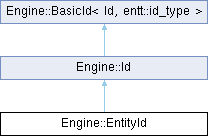
Represents a unique identifier for an entity in the Engine's entity-component system. An EntityId is just Id with utility methods to manage components associated with the entity but not the core. More...
#include <EntityId.hpp>
Public Types | |
| using | ValueType = Id::ValueType |
| The underlying value type of the EntityId, which is the same as Engine::Id::ValueType. | |
| Public Types inherited from Engine::Id | |
| using | ValueType = entt::id_type |
Public Member Functions | |
| constexpr | EntityId (ValueType value_=NullValue()) |
| Constructs an EntityId with the given value. By default, it constructs a null EntityId. | |
| constexpr | EntityId (Id id) |
| Constructs an EntityId from an Engine::Id. This allows for implicit conversion from Engine::Id to EntityId. | |
| bool | IsValid (const Engine::Core &core) const |
| Checks if the EntityId is valid. An EntityId is considered valid if it corresponds to an existing entity in the Core's registry. | |
| template<typename TComponent> | |
| decltype(auto) | AddComponent (Engine::Core &core, TComponent &&component) |
| Add a component to an entity. | |
| template<typename TComponent, typename... TArgs> | |
| decltype(auto) | AddComponent (Engine::Core &core, TArgs &&...args) |
| Add a component to an entity. | |
| template<typename TComponent, typename... TArgs> | |
| decltype(auto) | AddComponentIfNotExists (Engine::Core &core, TArgs &&...args) |
| Add a component to an entity if it does not already exist. | |
| template<typename... TComponent> | |
| bool | HasComponents (const Engine::Core &core) const |
| Check if entity have one or multiple component's type. | |
| template<typename TTempComponent, typename... TArgs> | |
| decltype(auto) | AddTemporaryComponent (Engine::Core &core, TArgs &&...args) |
| Add a temporary component to an entity. Temporary component are removed when calling RemoveTemporaryComponents system. | |
| template<typename... TComponent> | |
| decltype(auto) | GetComponents (Engine::Core &core) |
| Get components of type TComponent from an entity. | |
| template<typename... TComponent> | |
| decltype(auto) | GetComponents (Engine::Core &core) const |
| Get components of type TComponent from the entity. | |
| template<typename TComponent> | |
| decltype(auto) | TryGetComponent (Engine::Core &core) |
| Try to get a component of type TComponent from the entity. It returns a pointer to the component if it exists, or nullptr if it does not exist. | |
| template<typename TComponent, class... TFunctions> | |
| void | UpdateComponent (Engine::Core &core, TFunctions &&...functions) |
| Update a component values through functions. This allows user so also call on_update registry's callback. | |
| template<typename TComponent> | |
| void | RemoveComponent (Engine::Core &core) |
| Remove a component from an entity. | |
| Public Member Functions inherited from Engine::Id | |
| constexpr | Id (ValueType value_=NullValue()) |
| Constructor for Id. | |
| constexpr | operator ValueType () const |
| Implicit conversion operator to the underlying entt::id_type, allowing seamless use of Id instances where entt::id_type is expected. | |
| Public Member Functions inherited from Engine::BasicId< Id, entt::id_type > | |
| constexpr bool | IsNull (void) const |
| Checks if the ID is null/invalid by comparing its value to the null value defined by the derived class. | |
Static Public Member Functions | |
| static constexpr EntityId | Null () |
| Returns a null EntityId. A null EntityId is an EntityId that does not correspond to any valid entity in the registry. | |
| static void | RemoveTemporaryComponents (Core &core) |
| Remove all temporary components from the registry. This system should be called at the end of each loop to ensure that temporary components are removed after they have been used. | |
| Static Public Member Functions inherited from Engine::Id | |
| static constexpr ValueType | NullValue (void) |
| Get the null value for this ID type. This returns the null value defined by EnTT's id_type, which is typically. | |
| static constexpr Id | Null (void) |
| Get a null instance of Id, which has its value set to the null value defined by NullValue(). | |
| Static Public Member Functions inherited from Engine::BasicId< Id, entt::id_type > | |
| static constexpr Id | Null (void) |
| Get the null value for this ID type. This should be defined by the derived class to specify what constitutes a null/invalid ID. | |
Static Private Attributes | |
| static std::unordered_map< std::type_index, std::function< void(Core &)> > | temporaryComponent = {} |
Additional Inherited Members | |
| Public Attributes inherited from Engine::BasicId< Id, entt::id_type > | |
| entt::id_type | value |
| The underlying value of the ID. | |
Detailed Description
Represents a unique identifier for an entity in the Engine's entity-component system. An EntityId is just Id with utility methods to manage components associated with the entity but not the core.
- Note
- EntityId maintains the same memory footprint as its underlying ValueType (Engine::Id).
- See also
- Engine::Id
- Engine::Core
Member Typedef Documentation
◆ ValueType
The underlying value type of the EntityId, which is the same as Engine::Id::ValueType.
Constructor & Destructor Documentation
◆ EntityId() [1/2]
Constructs an EntityId with the given value. By default, it constructs a null EntityId.
- Parameters
-
v The value to initialize the EntityId with. If not provided, it defaults to the null value defined by Engine::Id.
◆ EntityId() [2/2]
|
constexpr |
Constructs an EntityId from an Engine::Id. This allows for implicit conversion from Engine::Id to EntityId.
- Parameters
-
id The Engine::Id to convert.
Member Function Documentation
◆ AddComponent() [1/2]
| decltype(auto) Engine::EntityId::AddComponent | ( | Engine::Core & | core, |
| TArgs &&... | args ) |
Add a component to an entity.
- Template Parameters
-
TComponent The type of the component to add to the registry. TArgs The types of the arguments to construct the component in-place in the registry.
- Parameters
-
core The Core instance whose registry is used to store the component. args The arguments to construct the component in-place in the registry.
- Returns
- A reference to the added component.
- Todo
- put the log in the core emplace
◆ AddComponent() [2/2]
| decltype(auto) Engine::EntityId::AddComponent | ( | Engine::Core & | core, |
| TComponent && | component ) |
Add a component to an entity.
- Template Parameters
-
TComponent The type of the component to add to the registry.
- Parameters
-
core The Core instance whose registry is used to store the component. component The rvalue of the component to add to the registry.
- Returns
- A reference to the added component.
- Todo
- put the log in the core emplace
◆ AddComponentIfNotExists()
| decltype(auto) Engine::EntityId::AddComponentIfNotExists | ( | Engine::Core & | core, |
| TArgs &&... | args ) |
Add a component to an entity if it does not already exist.
- Template Parameters
-
TComponent type to add to registry. TArgs type used to create the component.
- Parameters
-
core registry used to store the component. args parameters used to instanciate component directly in registry memory.
- Returns
- reference of the added component.
◆ AddTemporaryComponent()
| decltype(auto) Engine::EntityId::AddTemporaryComponent | ( | Engine::Core & | core, |
| TArgs &&... | args ) |
Add a temporary component to an entity. Temporary component are removed when calling RemoveTemporaryComponents system.
- Template Parameters
-
TTempComponent type to add to registry TArgs type used to create the component
- Parameters
-
core registry used to store the component args parameters used to instanciate component directly in registry memory
- Returns
- reference of the added component
◆ GetComponents() [1/2]
| decltype(auto) Engine::EntityId::GetComponents | ( | Engine::Core & | core | ) |
Get components of type TComponent from an entity.
- Template Parameters
-
TComponent The type of the component to get from the registry.
- Parameters
-
core The Core instance whose registry is used to store the component.
- Returns
- The components of type TComponent from the entity.
◆ GetComponents() [2/2]
| decltype(auto) Engine::EntityId::GetComponents | ( | Engine::Core & | core | ) | const |
Get components of type TComponent from the entity.
- Template Parameters
-
TComponent The type of the component to get from the registry.
- Parameters
-
core The Core instance whose registry is used to store the component.
- Returns
- The components of type TComponent from the entity.
◆ HasComponents()
| bool Engine::EntityId::HasComponents | ( | const Engine::Core & | core | ) | const |
Check if entity have one or multiple component's type.
- Template Parameters
-
TComponent components to check.
- Parameters
-
core context used to check if the entity have the component in the core's registry.
- Returns
- true if entity have all requested component, false otherwise.
◆ IsValid()
|
inline |
◆ Null()
|
staticconstexpr |
◆ RemoveComponent()
| void Engine::EntityId::RemoveComponent | ( | Engine::Core & | core | ) |
◆ RemoveTemporaryComponents()
|
inlinestatic |
Remove all temporary components from the registry. This system should be called at the end of each loop to ensure that temporary components are removed after they have been used.
- Parameters
-
core The Core instance whose registry is used to store the components.
◆ TryGetComponent()
| decltype(auto) Engine::EntityId::TryGetComponent | ( | Engine::Core & | core | ) |
Try to get a component of type TComponent from the entity. It returns a pointer to the component if it exists, or nullptr if it does not exist.
- Template Parameters
-
TComponent The type of the component to get from the registry.
- Parameters
-
core The Core instance whose registry is used to store the component.
- Returns
- A pointer to the component of type TComponent from the entity if it exists, or nullptr if it does not exist.
◆ UpdateComponent()
| void Engine::EntityId::UpdateComponent | ( | Engine::Core & | core, |
| TFunctions &&... | functions ) |
Update a component values through functions. This allows user so also call on_update registry's callback.
- Template Parameters
-
TComponent The type of the component to update. ...TFunctions Function types that will be applied to component
- Parameters
-
core The Core instance whose registry is used to store the component. ...functions Function types that will be applied to component
Member Data Documentation
◆ temporaryComponent
|
inlinestaticprivate |
The documentation for this struct was generated from the following files:
- src/engine/src/entity/EntityId.hpp
- src/engine/src/entity/EntityId.ipp