Abstract plugin class that add some utility functions to make it easier to register systems and resources. More...
#include <APlugin.hpp>
Public Member Functions | |
| APlugin (Core &core) | |
| Constructor for APlugin. It takes a reference to the Core, which is used to register systems and resources in the Bind method. | |
| virtual void | Bind (void)=0 |
| Pure virtual method that must be implemented by derived plugin classes. This method is called when the plugin is added to the engine, and is where the plugin should register its systems, resources, and any other functionality it provides to the engine. | |
| template<CScheduler TScheduler, typename... Systems> | |
| decltype(auto) | RegisterSystems (Systems... systems) |
| Register systems to a scheduler. | |
| template<typename TResource> | |
| TResource & | RegisterResource (TResource &&resource) |
| Register a resource in the core. | |
| template<CPlugin... TPlugins> | |
| void | RequirePlugins () |
| Add a plugin to the core. | |
| template<CScheduler TScheduler, typename... Args> | |
| TScheduler & | RegisterScheduler (Args &&...args) |
| Register a scheduler in the core. | |
| Core & | GetCore () |
| Get a reference to the core. This can be used to register systems and resources in the Bind method. | |
| Public Member Functions inherited from Engine::IPlugin | |
| virtual | ~IPlugin ()=default |
| Virtual destructor for IPlugin. | |
Private Member Functions | |
| template<CPlugin TPlugin> | |
| void | RequirePlugin () |
| Add a plugin to the core if it is not already added. | |
Private Attributes | |
| Core & | _core |
| Reference to the core, which is used to register systems and resources in the Bind method. | |
Detailed Description
Abstract plugin class that add some utility functions to make it easier to register systems and resources.
Constructor & Destructor Documentation
◆ APlugin()
|
explicit |
Member Function Documentation
◆ Bind()
|
pure virtual |
Pure virtual method that must be implemented by derived plugin classes. This method is called when the plugin is added to the engine, and is where the plugin should register its systems, resources, and any other functionality it provides to the engine.
- See also
- Engine::Core
- Engine::APlugin
Implements Engine::IPlugin.
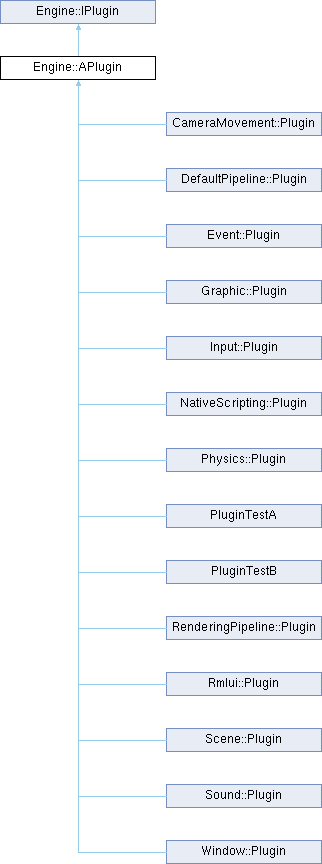
Implemented in CameraMovement::Plugin, DefaultPipeline::Plugin, Event::Plugin, Example::App, Example::App, Example::App, Example::App, Example::NcursesPlugin, Example::RaylibPlugin, Example::SfmlPlugin, Graphic::Plugin, Input::Plugin, NativeScripting::Plugin, Physics::Plugin, PluginTestA, PluginTestB, RenderingPipeline::Plugin, Rmlui::Plugin, Scene::Plugin, Sound::Plugin, and Window::Plugin.
◆ GetCore()
| Core & Engine::APlugin::GetCore | ( | ) |
Get a reference to the core. This can be used to register systems and resources in the Bind method.
- Returns
- A reference to the core.
- See also
- Engine::Core
◆ RegisterResource()
| TResource & Engine::APlugin::RegisterResource | ( | TResource && | resource | ) |
Register a resource in the core.
- Template Parameters
-
TResource The type of the resource to register.
- Parameters
-
resource The resource to register.
- Returns
- A reference to the registered resource.
- See also
- Engine::Core::RegisterResource
◆ RegisterScheduler()
| TScheduler & Engine::APlugin::RegisterScheduler | ( | Args &&... | args | ) |
Register a scheduler in the core.
- Template Parameters
-
...Args The types of the arguments to pass to the scheduler constructor. TScheduler The type of the scheduler to register.
- Parameters
-
...args The arguments to pass to the scheduler constructor.
- Returns
- A reference to the registered scheduler.
◆ RegisterSystems()
| decltype(auto) Engine::APlugin::RegisterSystems | ( | Systems... | systems | ) |
Register systems to a scheduler.
- Template Parameters
-
TScheduler The type of the scheduler to register the systems to. ...Systems The types of the systems to register. They should be invocable with a Core reference as the first parameter.
- Parameters
-
...systems The systems to register. They should be invocable with a Core reference as the first parameter.
- Returns
- The registered systems.
◆ RequirePlugin()
|
private |
Add a plugin to the core if it is not already added.
- Template Parameters
-
TPlugin The type of the plugin to add.
◆ RequirePlugins()
| void Engine::APlugin::RequirePlugins | ( | ) |
Add a plugin to the core.
- Template Parameters
-
...TPlugins The types of the plugins to add. They should be derived from APlugin.
- See also
- Engine::APlugin::RequirePlugin
Member Data Documentation
◆ _core
|
private |
Reference to the core, which is used to register systems and resources in the Bind method.
The documentation for this class was generated from the following files:
- src/engine/src/plugin/APlugin.hpp
- src/engine/src/plugin/APlugin.cpp
- src/engine/src/plugin/APlugin.ipp